
Intelligent Surgical Robot

Applicable Experimental Animals
- Rats
- Mice

Applicable Research Fields
- Intracranial implantation of flexible electrodes
- Intracranial implantation of silk protein electrodes
- Intracranial implantation of rigid electrodes
- Intracranial implantation of optical fibers
- Intracranial injection of viruses and drugs
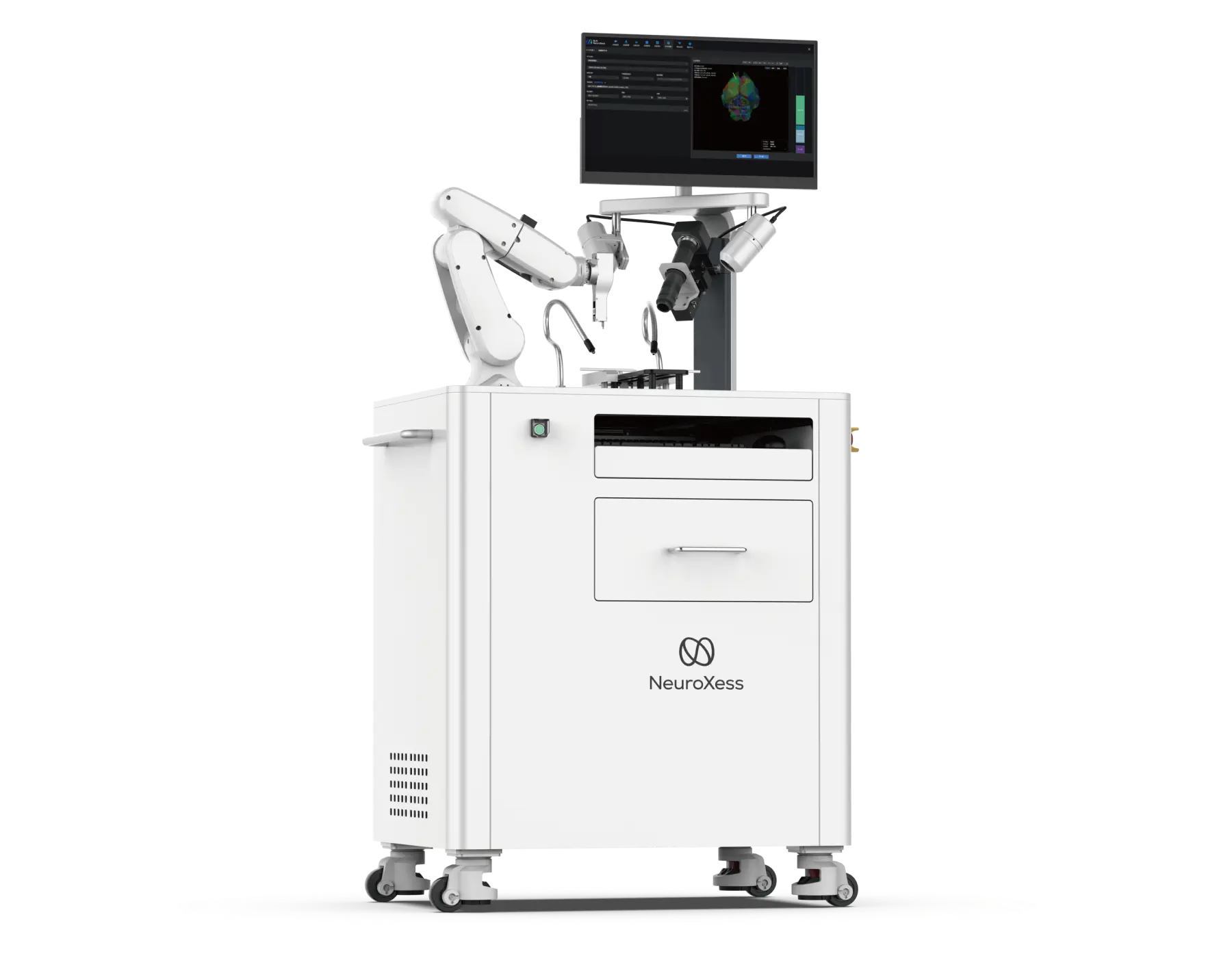
Advantages
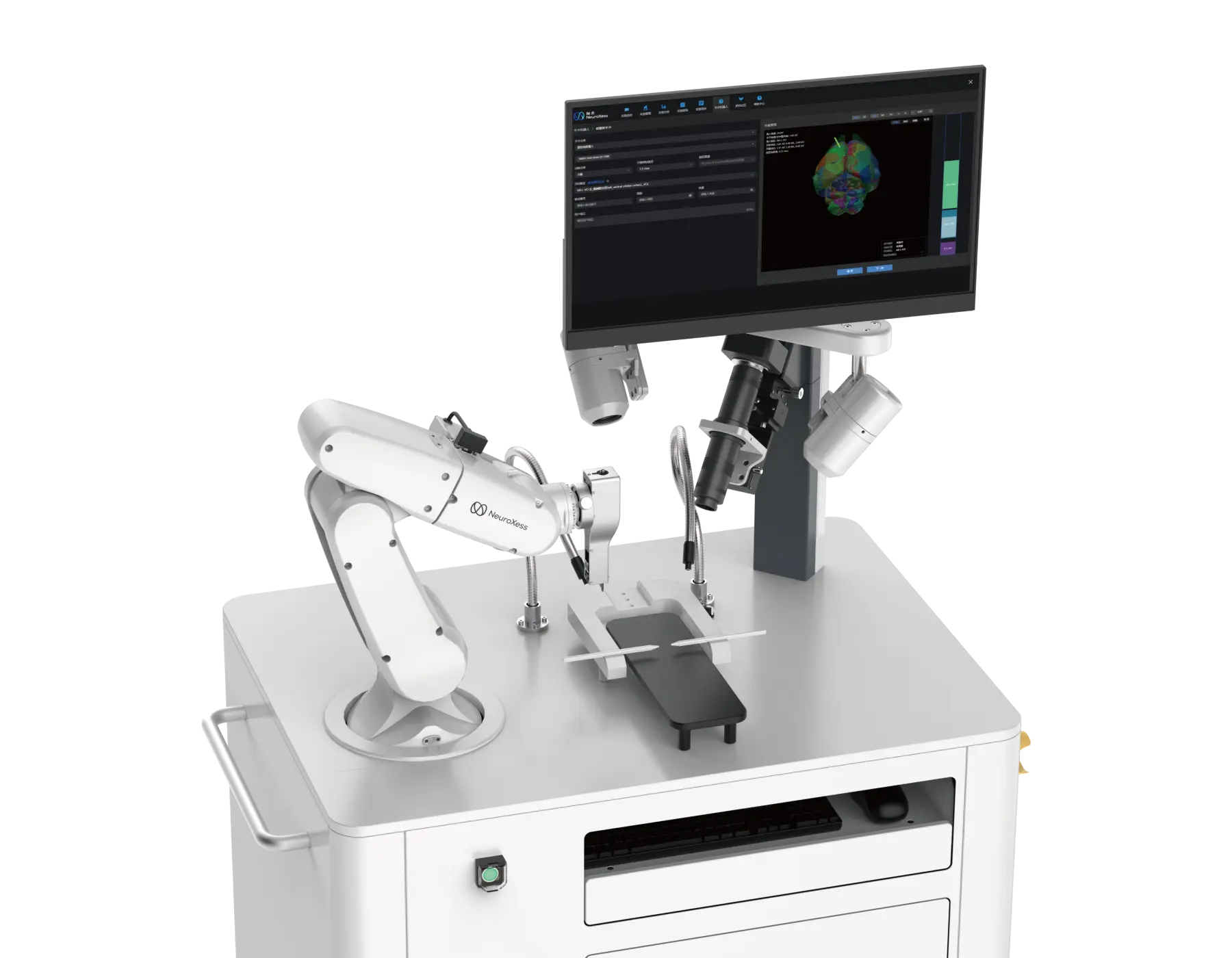
Rich Application Scenarios
- Automatic drilling and customizable bone window shapes to adapt to various cranial surgery experiments;
- Supports implantation of NeuroXess self-developed flexible electrodes, silk protein electrodes, common rigid electrodes, optical fibers and drug injection.
Automated Skull Surface Recognition
- High-resolution binocular cameras realize precise skull reconstruction;
- The tilt angle of the skull surface can be automatically calculated to eliminate tedious manual skull leveling and simplify surgical procedures.
Rapid and High-Precision Positioning
- Fast and accurate positioning according to target locations and end effector characteristics;
- The six-axis robotic arm combined with intelligent algorithms can precisely reach target positions along pre-planned paths.
User-Friendly Surgery
- Clear and concise surgical procedure guidance configured by the software according to surgical types, allowing users to operate smoothly without errors by following the guidance;
- Surgical data can be displayed and recorded in real time during the operation, and users can input customized information into the system in real time;
- All surgical data is systematically managed by the software after the operation.
Intelligent Positioning
- The built-in standard 2D planar brain atlas for rats and mice, and a 3D brain model established based on the atlas;
- Allows flexible setting and adjustment of target brain region coordinates;
- Intelligently plans the optimal implantation path based on brain regions and electrode characteristics.
Highly Integrated and Mobile
- Integrates robotic arms, binocular cameras, microscopes, light sources, surgical navigation, and other modules into one unit;
- The movable trolley design enables flexible selection of surgical environments.
Surgical Procedure
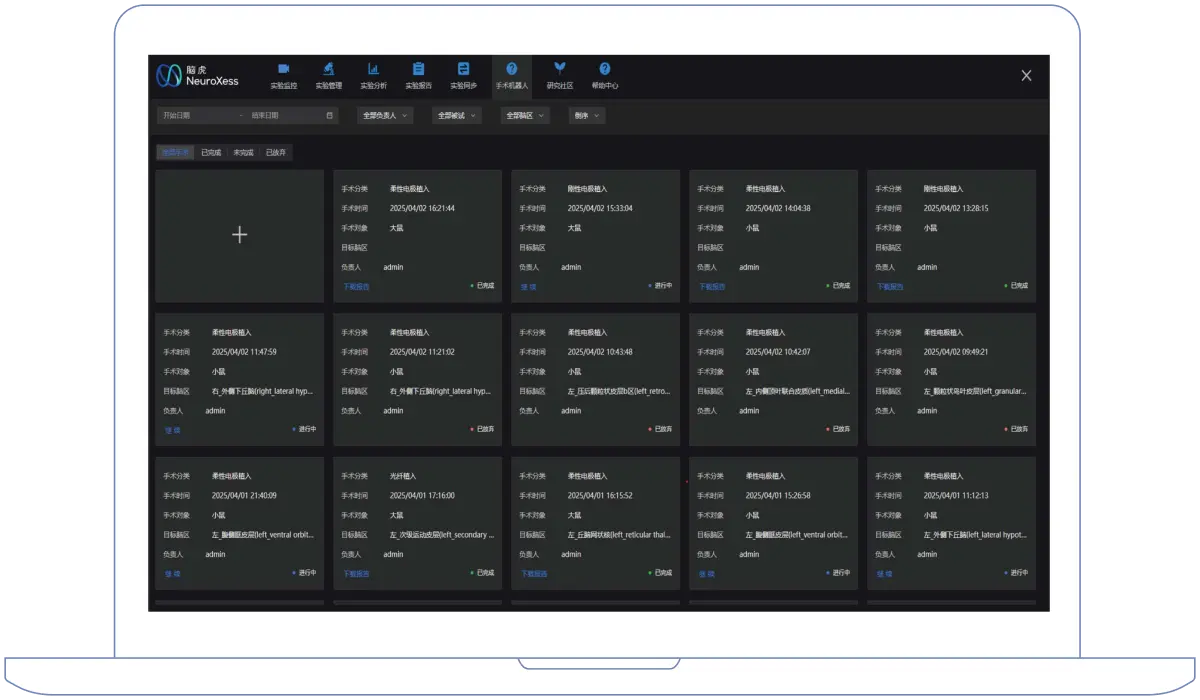
Surgical management
·Users can view the status of all surgeries, create new surgeries, download surgical experiment reports, and invoke previously established but unperformed surgeries on the surgical management page;
·The surgical management page enables efficient management of all surgeries, allowing classification and filtering by surgery time and status.
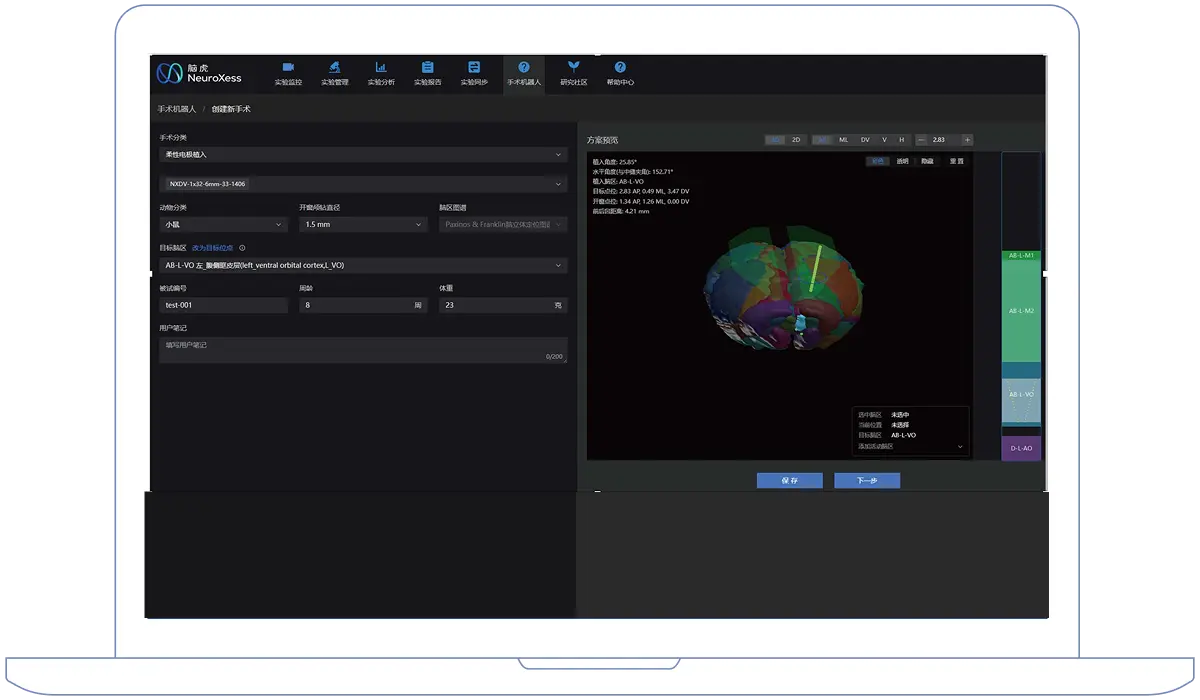
New surgery
·Users can define key information such as animal type, target brain region/coordinates, electrode or other implant models, etc.;
·The software automatically plans the optimal implantation path based on the implantation information defined by the user;
·Users can visually preview the planned path in 3D/2D brain models and further confirm or adjust it.
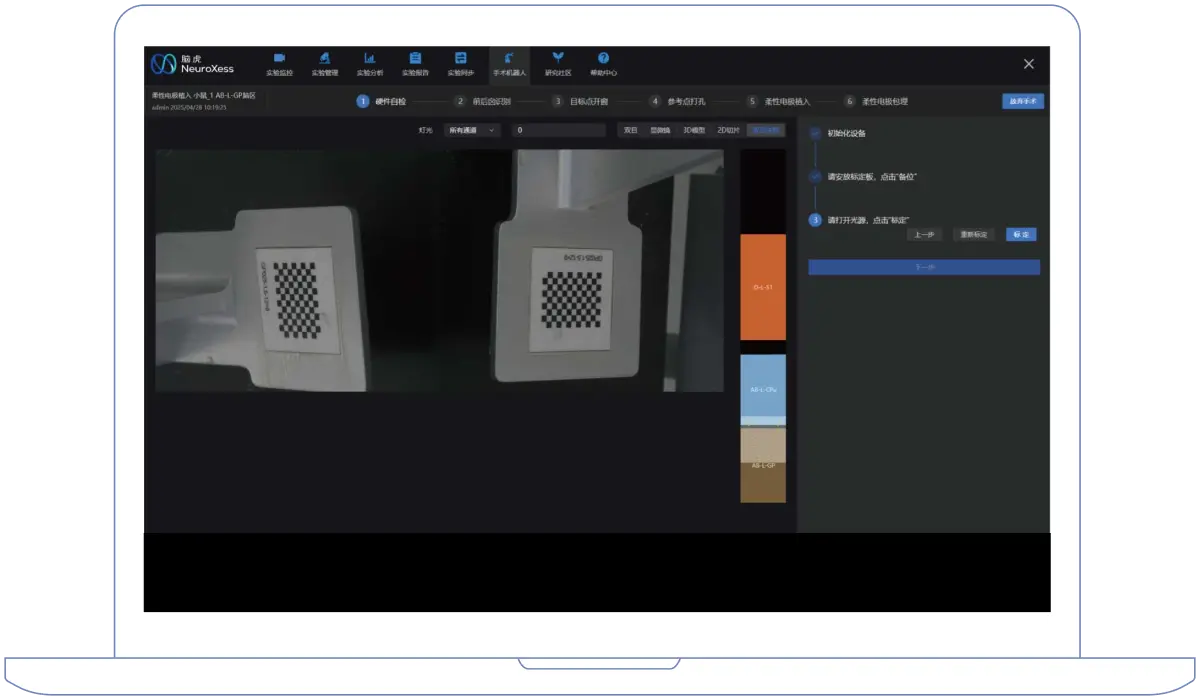
Hardware self-test
·Ensure system accuracy by automatically performing visual system precision calibration;
·The self-test process is highly automated for convenient user operation.
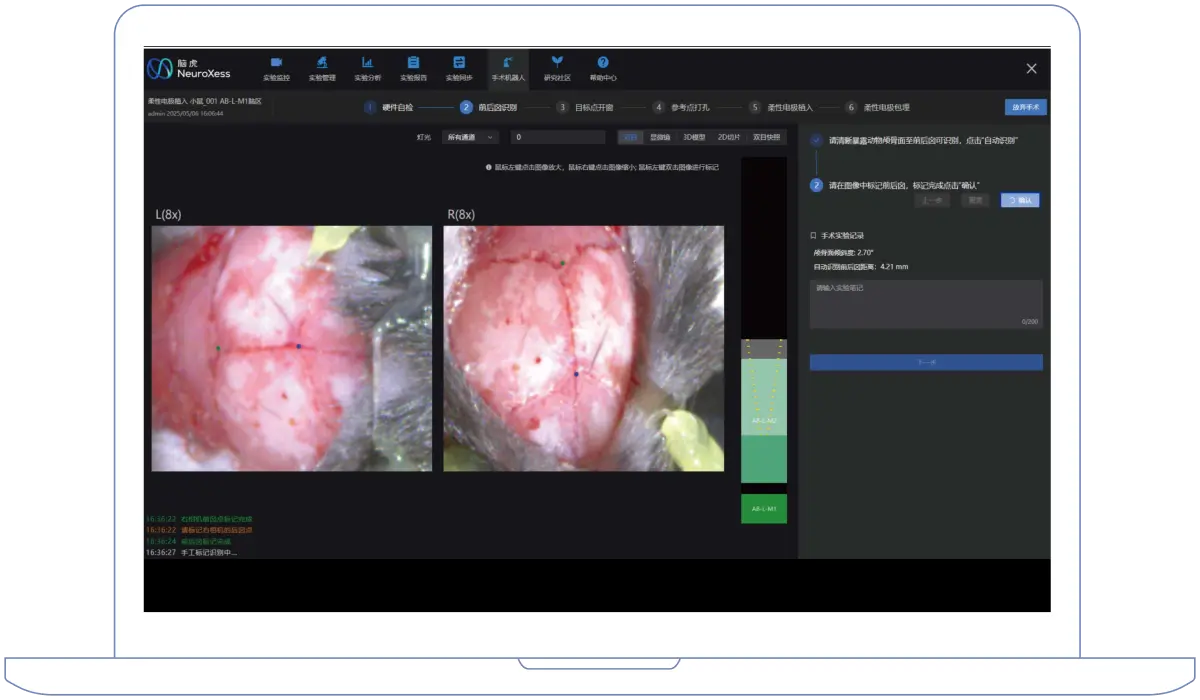
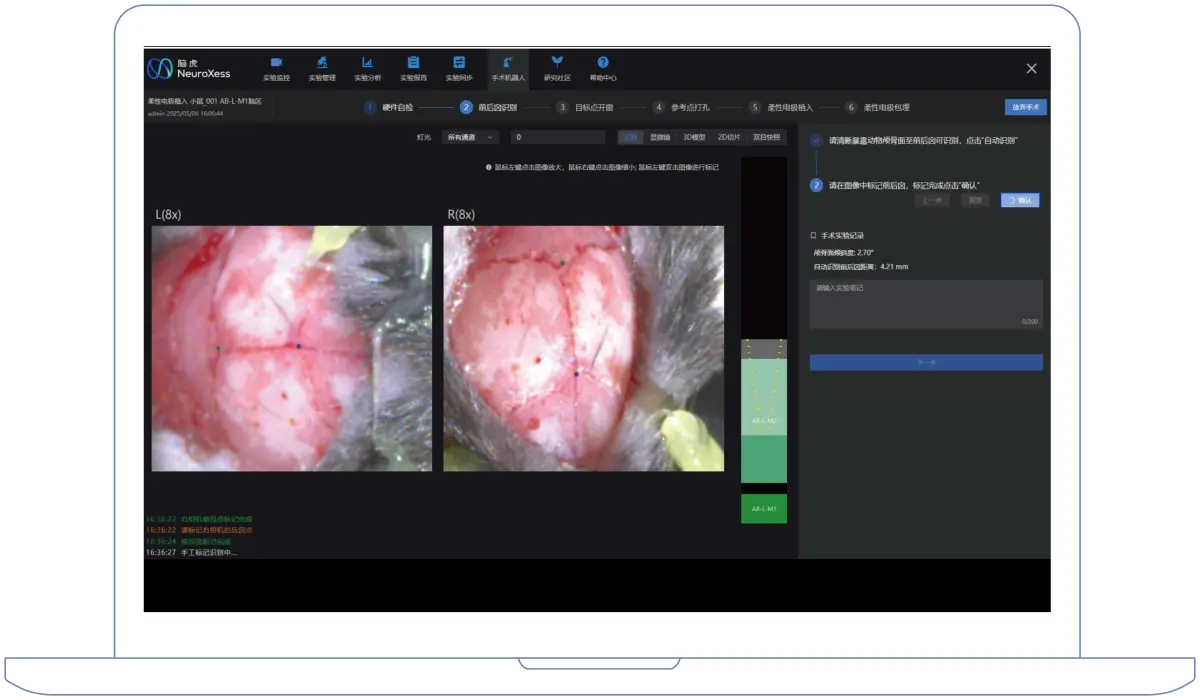
Automatic identification of bregma/lambda
·Automatically identify the skull surface, and then automatically calculate the inclination angle of the skull surface;
·The built-in algorithm of the software can automatically identify and mark the bregma point and lambda point on the skull surface.
Automatic craniotomy
·The six-axis robotic arm works with the cranial drill to automatically create a bone window at the target position;
·Supports users in defining the positions for installing screws or ground wires through automated sequential drilling as required;
·Users can select cranial drill bits of different diameters and bone window shapes according to their needs.
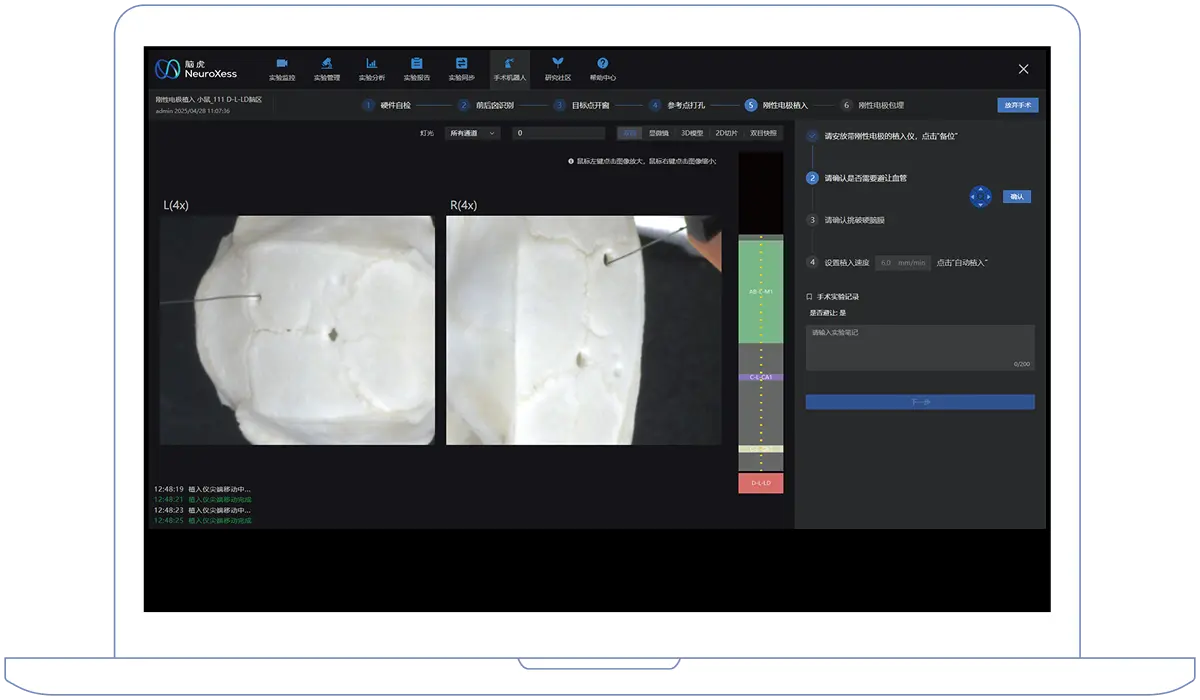
Automatic implantation
·Users can select different end-effectors according to the implant type, including optional configurations such as flexible electrode implanter, rigid electrode implanters, optical fiber implanters, and drug injectors;
·After replacing the end-effector, the robotic arm can automatically position itself above the craniotomy area to complete tasks such as electrode implantation and drug injection, with the operation of the end-effectors guided by the software throughout the entire process.
Product
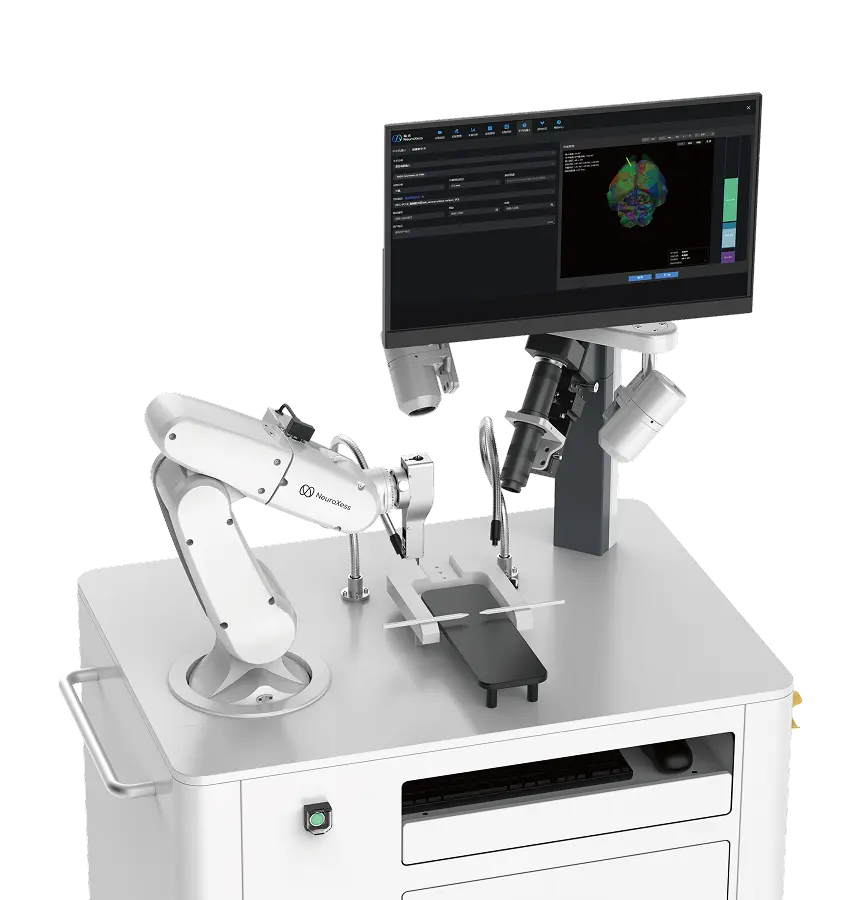
Host
Mechanical arm + Vision system + Light source system
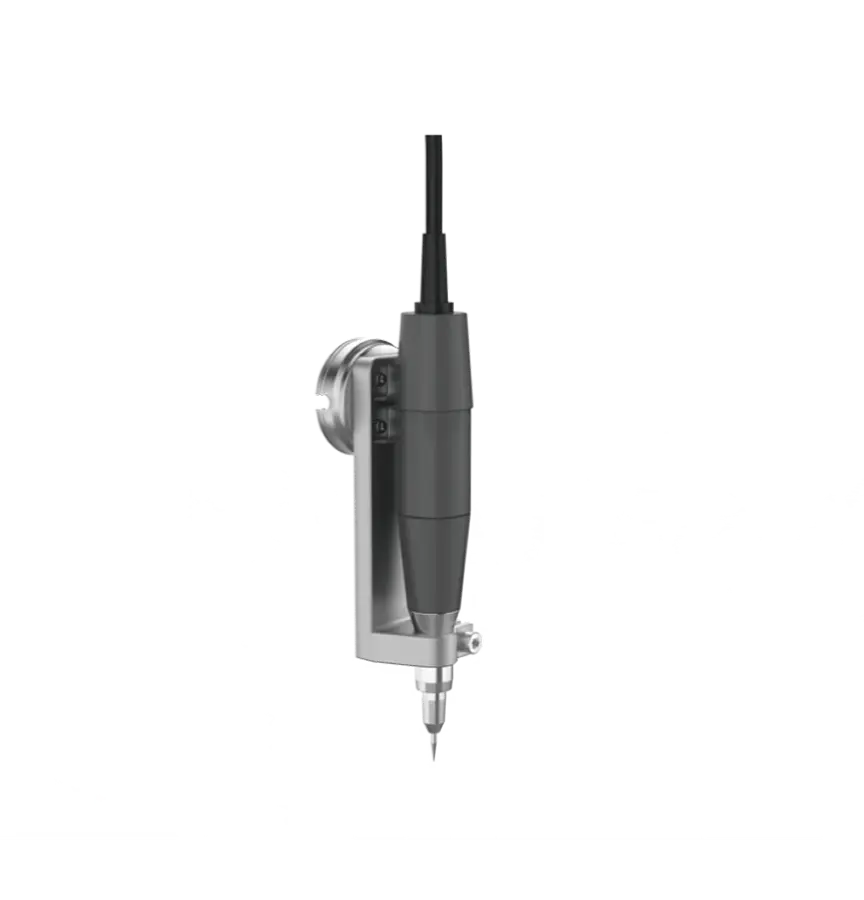
Cranial drill
Paired with the six-axis mechanical arm, the cranial drill can accurately move to the target position and drill into the skull, with a hole diameter range of 0.5-2.0 mm.
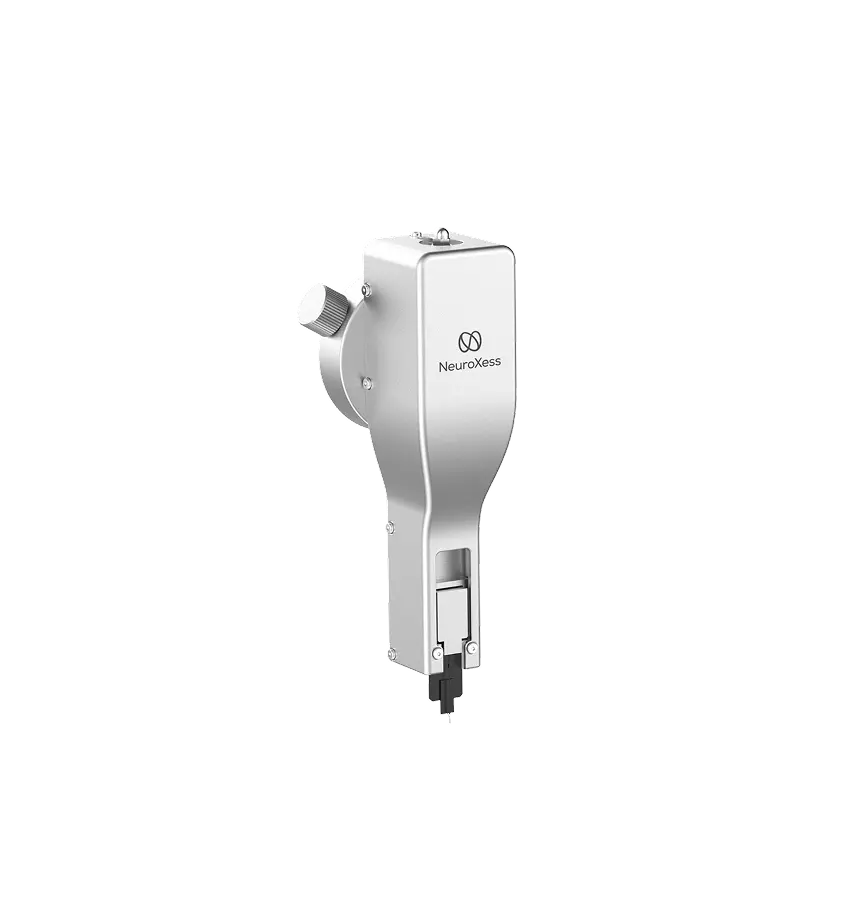
Flexible electrode implanter
Suitable for implanting flexible electrodes independently developed by NeuroXess, compatible with different models of flexible electrodes.
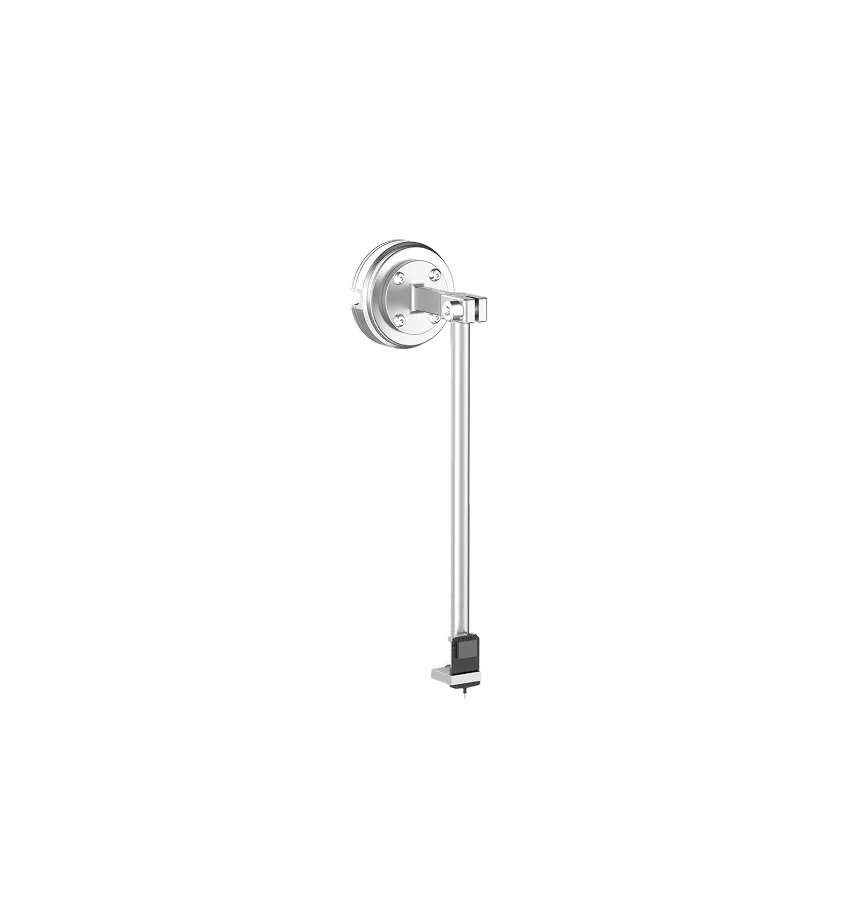
Rigid electrode implanter
Compatible with the silk protein electrodes independently developed by NeuroXess and common rigid electrodes such as silicon-based electrodes and microwire electrodes. It is capable of performing acute signal acquisition.
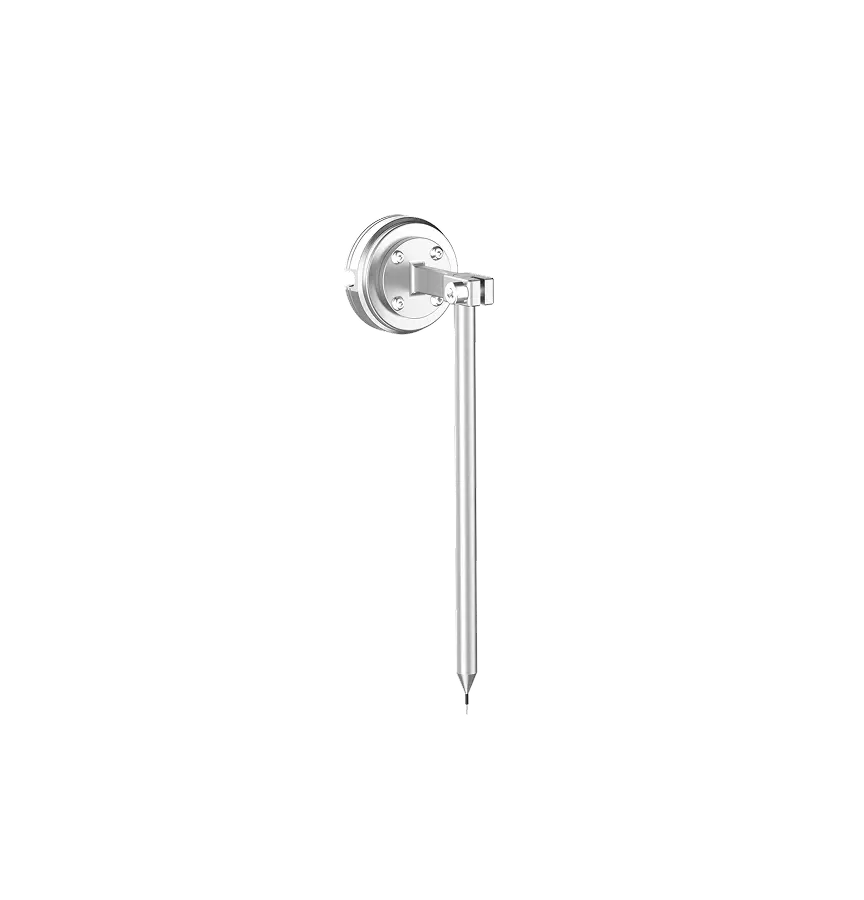
Optical fiber implanter
Used for brain implantation of optical fiber ferrules. Compatible with common optical fiber ferrules on the market.
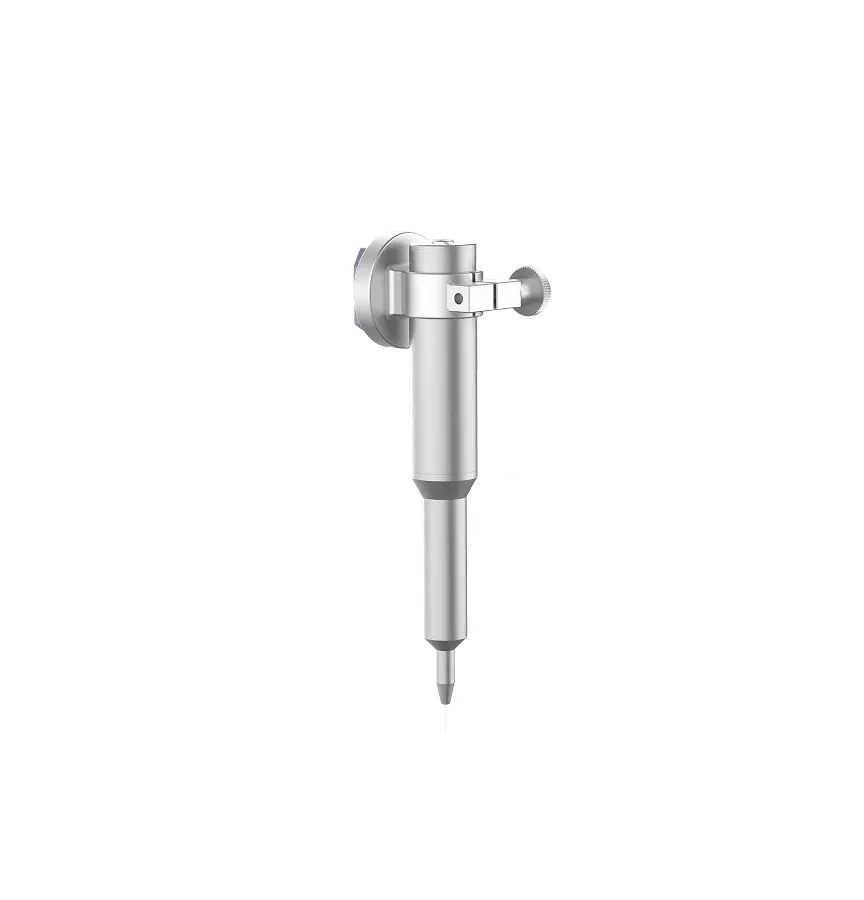
Drug injector
Used for automated micro-viral injection or other drug injections into the brain. Equipped with a precision Hamilton microsyringe.